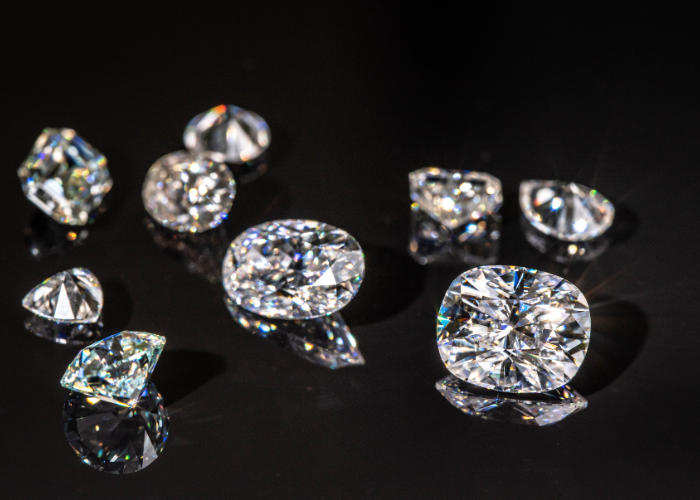

A few months ago, I found myself standing in a diamond cutting workshop in Melbourne, watching a gemologist polish a small, brilliant stone under a blindingly bright light. The diamond looked perfect — pure, white, sparkling. But here’s the twist: it was made in a lab, not dug out of the earth.
I’ll admit, until that moment, I wasn’t entirely sure what the real difference was between lab grown vs natural diamonds. They looked identical to the naked eye. Both could make a proposal sparkle, both could sit elegantly in a gold ring. But as I discovered, the story behind each one — how it’s formed, what it means, and even how it makes you feel — can be surprisingly different.
The Origin Story: Earth’s Heat vs Human Innovation
Let’s start with where these gems actually come from.
Natural diamonds are, quite literally, the stuff of legend. They form deep within the Earth’s mantle, about 150 to 200 kilometres below the surface, under intense heat and pressure — we’re talking over a billion years of natural creation. When volcanic eruptions push them closer to the surface, miners eventually extract them from kimberlite pipes. It’s ancient geology turned luxury.
Lab-grown diamonds, on the other hand, are born in a much more controlled environment. Scientists use advanced technology to replicate those exact same conditions that nature perfected long ago. There are two main methods: HPHT (High Pressure, High Temperature) and CVD (Chemical Vapour Deposition).
If you’re curious how that actually works, this article on lab made diamonds gives a really neat, step-by-step breakdown of the process. It’s a bit like watching modern science recreate nature’s slow magic — only faster and cleaner.
The result? A diamond that’s chemically, physically, and optically identical to one pulled from the ground. So yes — it’s a real diamond. No glass. No “fakes.” Just a different origin story.
You Might Not Know This: Even Experts Struggle to Tell the Difference
Here’s something I didn’t expect: even seasoned jewellers often need specialised instruments to tell whether a diamond is mined or lab-created. Both rate the same on the Mohs hardness scale (that’s a perfect 10, by the way), and both refract light in exactly the same way.
One gemologist I spoke to put it perfectly:
“If I handed you two diamonds — one mined, one lab-grown — you’d never know which was which. You’d just pick whichever one caught your eye first.”
That’s the reality. For most of us, it’s impossible to tell by sight alone. Which means the decision comes down less to appearance, and more to values.
The Price Conversation: Ethics, Affordability, and Emotion
Let’s talk about money — and meaning.
There’s no denying it: lab-grown diamonds generally cost less. You’ll often find them at 30–50% lower prices than their natural counterparts. That’s not because they’re inferior; it’s because they don’t require the vast infrastructure, labour, and logistics of traditional mining.
For couples trying to balance romance and reality, that can be a game-changer. You can buy a bigger stone, or put the savings toward the honeymoon.
But the other side of that story — and this is where it gets interesting — is emotional value. Some people still feel a powerful pull toward the idea of a diamond forged by time, pressure, and the planet itself. There’s something deeply romantic about that thought.
It’s a bit like the difference between vintage wine and a well-made new release. One carries the weight of history; the other, the thrill of innovation. Both can be beautiful.
Environmental Impact: Digging Deep vs Growing Clean
This is where the conversation really heats up.
Traditional diamond mining has long been criticised for its environmental footprint — deforestation, carbon emissions, and sometimes questionable labour practices. Many mines today are trying to change that, implementing stricter sustainability standards and ethical sourcing policies. But still, there’s no escaping the fact that mining is intrusive by nature.
Lab-grown diamonds, by contrast, don’t require digging or displacing land. They use significantly less water and energy — although it’s worth noting that not all labs are powered equally. The cleanest facilities run on renewable energy, which drastically reduces their carbon footprint.
It’s not a black-and-white issue, though. As one sustainability expert told me,
“You can’t just say one is good and the other is bad. You have to look at how each one is produced.”
If you’re interested in diving deeper into the ethics and technical details, I found this excellent breakdown on lab grown vs natural diamonds. It’s balanced and surprisingly readable — perfect if you’re comparing options before a big purchase.
The Investment Factor: Will One Hold Its Value Better?
Ah, the age-old question — and one jewellers love to debate.
Natural diamonds have long been considered a store of value. Historically, they’ve maintained stable resale prices, largely because of limited supply and established demand. But that market is shifting. Younger buyers are less fixated on resale and more focused on ethics and design.
Lab-grown diamonds, meanwhile, are newer to the scene. Their value tends to depreciate faster because technology keeps improving — meaning they’re getting cheaper to produce each year. From an investment perspective, they’re not ideal for resale. But that’s not necessarily a deal-breaker.
Most people aren’t buying diamonds as an investment anymore. They’re buying them as symbols — of love, of achievement, of personal taste. And that emotional worth? It’s not something you can quantify on a spreadsheet.
The Australian Angle: What Local Buyers Are Choosing
Here in Australia, the shift toward lab-grown diamonds has been pretty noticeable. Especially among younger couples and environmentally conscious buyers.
According to several Melbourne jewellers I spoke with, sales of lab-grown diamonds have tripled in the last few years. One even said that for engagement rings under $10,000, more than half of clients now choose lab-grown.
It’s not just about price — it’s about transparency. Aussies like to know where their products come from. Whether it’s coffee, clothing, or gemstones, provenance matters.
That said, the romance of a natural diamond still holds a special kind of prestige. You’ll still find collectors, investors, and traditionalists who wouldn’t dream of choosing anything but a mined stone.
From a Jeweller’s Eye: Beauty Is Still in the Details
If you talk to a bench jeweller — someone who spends hours setting stones — they’ll tell you something fascinating. When it comes to craftsmanship, the beauty of a diamond, lab or natural, lies in the cut.
A well-cut diamond catches the light in ways that make you forget everything else. The sparkle, the fire, the brilliance — all of that comes from how it’s shaped, not how it’s sourced.
So whether it’s grown in a lab or born from the Earth, what truly matters is how that gem is brought to life once it’s in the hands of a skilled artisan.
So, Which One Should You Choose?
Here’s my honest take: there’s no wrong answer.
If you love the history, rarity, and timeless story of natural diamonds, that’s a beautiful choice. It’s the traditional symbol of everlasting love — and there’s real poetry in that.
If you’re drawn to innovation, sustainability, and a modern mindset, lab-grown diamonds are equally compelling. They’re real, ethical, and often more accessible.
At the end of the day, the right diamond is the one that speaks to you. The one that fits your values, your budget, and your story.
A Final Thought: What the Sparkle Represents
After spending weeks researching this piece — and yes, trying on a few rings along the way — I’ve come to see diamonds a little differently. They’re not just stones. They’re chapters in our lives.
A diamond might mark a promise, a milestone, or simply a moment of self-celebration. Whether it was grown in the Earth or in a lab, that sparkle carries meaning because you give it meaning.
So next time you catch a glimmer of light dancing off a ring or a pendant, take a moment. Remember that behind every diamond, there’s both science and story — and that’s what makes it truly shine.